Land requirement of wind energy
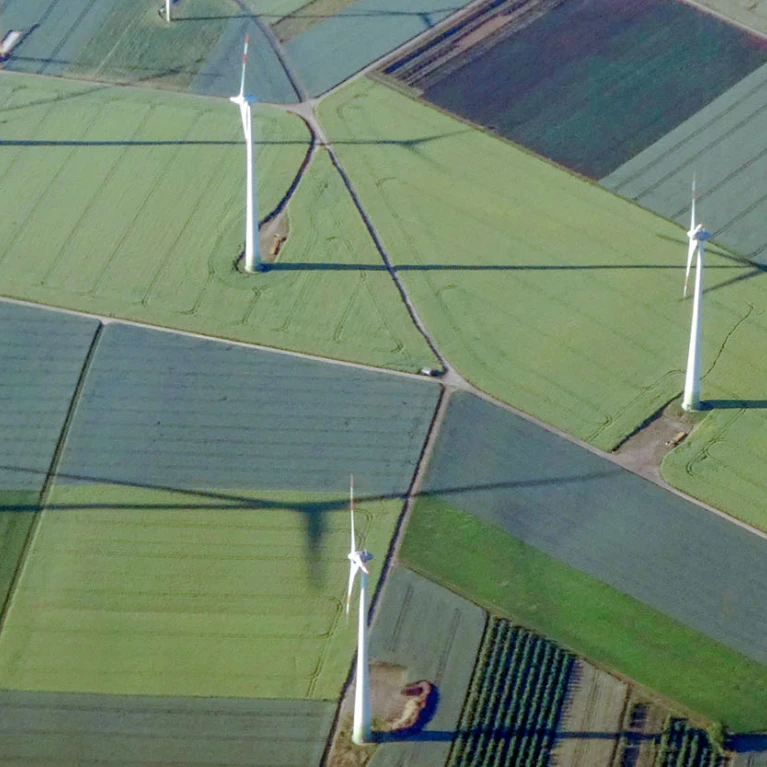
Wind turbines occupy different areas. When talking about the area for wind energy, it usually refers to the entire space occupied by a facility. This includes the areas swept by the rotors and the necessary distance to other wind turbines and facilities in a wind park. This total land requirement per facility depends on its size, that is, its height and the length of the rotors. According to a study on the land potentials of wind energy onshore the area can range from about 3 to 5.2 hectares per megawatt (MW) of capacity depending on the plan. A facility with a 6 MW capacity would then require about 18 to 30 hectares - airspace. On the ground, this area remains largely usable for agriculture or forestry. It only affects the airspace, which is important for the spacing of the facilities.
This knowledge about the land use is essential for the expansion of wind energy in Germany. It aids in assessing the spatial potential of a region or our country. Furthermore, it serves as a basis for arguments regarding political objectives for the expansion of wind energy. Understanding the performance to be generated from wind energy or the available land, the deployment of this renewable energy can be planned more reliably.
Die oben genannten Zahlen sagen nichts über die benötigte Bodenfläche einer einzelnen Windenergieanlage aus. Der Bodenverbrauch oder die versiegelte Fläche durch eine einzelne Anlage sind deutlich geringer als die für Planung und Bauphase benötigte Fläche.
Temporary land requirement for the construction of a wind turbine
For the construction phase of a wind turbinea large area is required to carry out all the works. The need consists of space for access, construction site setup, storage of building materials, and the assembly of the facilities.
Regarding the so-called access roadsinclude wide and stable access paths for the crane, its set-up area, and the required transport vehicles. If roads and paths exist, they are used and possibly widened and reinforced for heavy vehicles. This means no additional area needs to be permanently sealed. The access paths must currently be at least 4.5 meters wide. Additional areas may be needed so that vehicles can turn. Turning bays are temporarily laid out with aluminum panels or steel plates. They must be designed in such a way that the heavy special vehicles transporting the long rotor blades can safely drive to the installation site.
-

Representation of the crane set-up area (1.1) for a 6 MW wind turbine with access road (4), auxiliary crane area (5), assembly area (2), and lattice mast set-up area for the crane (6).
For temporary storage areasadditional areas are required for the individual materials and components of the wind turbine, including the long rotor blades, tower segments, and foundation elements.
Additional areas are also required during construction for the construction site setup and construction containers, which are necessary in the immediate vicinity.
Overall, a temporary area of around 5,000 to 10,000 square meters or 0.5 to 1 hectare is required. For comparison: a soccer field measures 7,140 square meters or 0.714 hectares.
Land use for the operation of a wind turbine
Once the construction phase is completed and the operation of the wind turbine begins, the required area decreases. The areas temporarily needed for construction can be dismantled and returned to their original use.
The only area permanently sealed during the construction phase was for the foundation with a diameter of 20 to 30 meters, which corresponds to an area of 700 to 1300 square meters. The tower itself has a small base area of about 180 to 210 square meters. Around the tower, a safety zone (no more than 25m in radius) is required, which can be used or renaturalized.
The access roads and the crane setup area, typically used for maintenance and repair work, remain in place. The area of 1,500 square meters for the crane is usually graveled with gravel and chippings and is not sealed. Thus, the resulting rainwater can percolate freely.
A wind turbine permanently requires an area of 0.25 to 0.5 hectares or 2,500 to 5,000 square meters. That is about half the size of a soccer field.
Conclusion
Wenn vom Flächenbedarf der Windenergie oder einer einzelnen Windenergieanlage die Rede ist, sollte man genau hinschauen oder nachfragen, welche Fläche gemeint ist. Es muss zwischen der Fläche für das Ausbauziel der gesamten Anlagen (von der ein großer Teil weiterhin nutzbar ist) sowie der Fläche am Boden während der Bauphase und im Betrieb der Anlage unterschieden werden.
A wind turbine occupies only a small portion of the land for the expansion target at ground level. During the construction phase, a larger temporary area of 5,000 to 10,000 square meters is required. The permanent land consumption in the operation of the facility reduces to about 2,500 to 5,000 square meters, with only a few hundred square meters being completely sealed. The rest remains available for agricultural or forestry use.