On equal footing with local communities
EEF sees itself as a partner of the community, emphasizing joint action on an equal footing. This ensures that local needs and regional specifics are considered in the planning process.

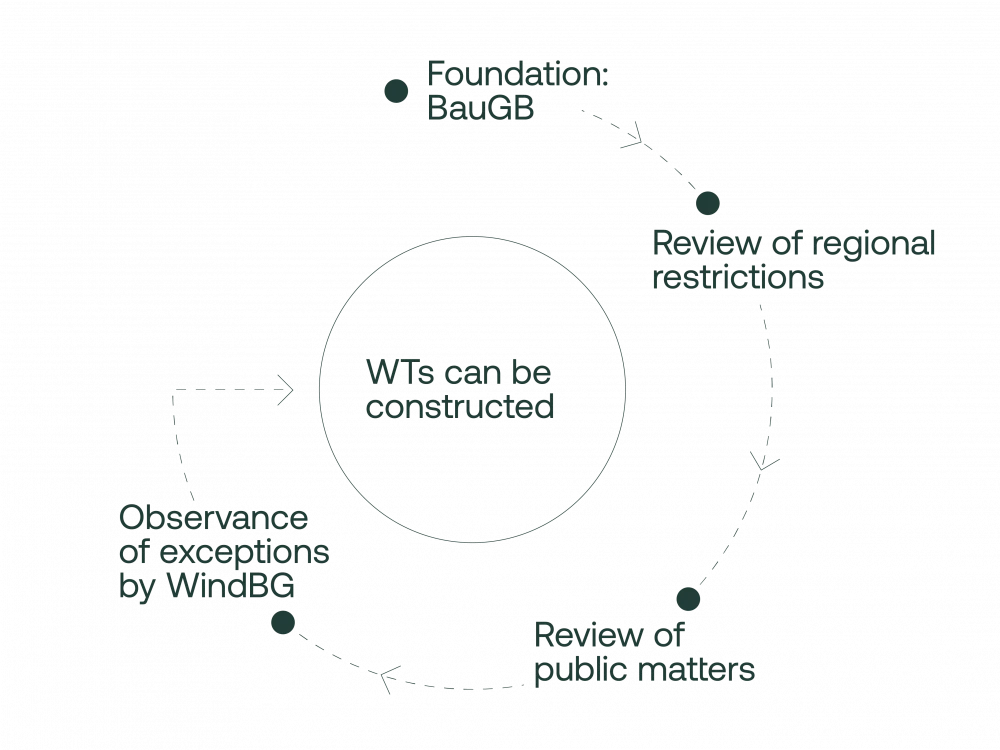
Planning law establishes the construction legal basis to utilize potential areas in the exterior for renewable energy projects.
ContactPlanning law brings communities and project developers together to collaboratively find suitable areas for renewable energy projects. This cooperation opens up valuable opportunities to identify potential areas and create the necessary planning law prerequisites.
Planning law aims to officially make identified areas accessible for the use of renewable energies, ensuring that all construction legal requirements are met.
The process of establishing the legal basis for construction at the municipal level begins with a formal decision by the Municipal Council - this based on a prior project presentation by EEF. The council's decision marks the official start of the process and signals the community's readiness to create the legal foundations for the project.

Development plans for wind turbines do not fundamentally differ from classic development plans for residential or commercial areas. They all have the following features:
• The development plan is adopted as a statute (local law).
• On the map (graphic determinations), locations of wind turbines and ancillary buildings are designated as buildable land.
• In the planning law provisions, provisions are made that go beyond the graphic representations, such as guidelines to prevent shading.
• Local building regulations are not necessarily required and are only conditionally sensible in the case of wind parks. Here, the municipality can specify architectural intentions.
A crucial part of the process is the involvement of the public and public interest bodies (TöB). Public participation informs residents and interest groups about the planned projects and provides them an opportunity to submit comments during the process. This step enhances transparency and contributes to the acceptance of the project.


EEF maintains a large regional and nationwide network. Through close collaboration with our partners, we pool expertise and resources to implement sustainable projects that meet today's and tomorrow's energy needs.
Learn more